


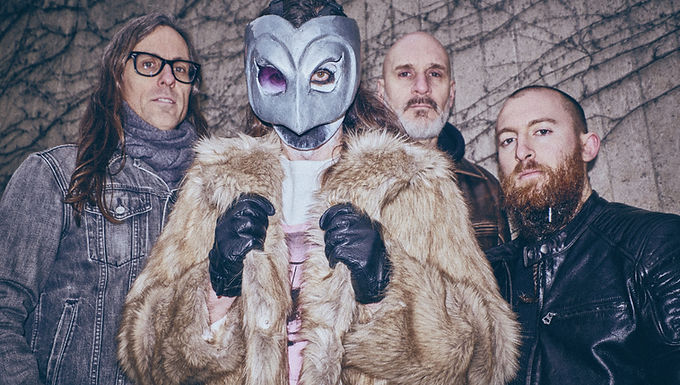
To celebrate the release of The Voyager Golden Banquet, Deliverance takes us behind the scenes of its new album. The band discusses its cinematic and space-inspired universe, its renewed songwriting process, the choice of the first singles, the evolution of its musical identity, and how these new songs are already being envisioned for the stage.
Hello everyone! Today we're joined by Deliverance. How are you both doing?
Pierre – We're doing great! How about you?
Étienne – Doing great, thanks!
Glad to hear it! How's your day been so far?
Pierre – It's been good! We've been doing interviews from 11 a.m. until 7 p.m. It kind of feels like we're saying the same things over and over again, but that's part of the job. At this point, we don't even remember what we've said, to whom, or when, so it's getting a little confusing. But we'll manage!
Étienne – It's been a busy promo day, which is great.
Today we're here to talk about your new album, The Voyager Golden Banquet, which comes out on May 22. If you had to describe it in just one word, what would it be?
Pierre – Space. Or spatial, if you prefer.
That works for me! Why that word?
Pierre – Because everything revolves around that concept: the lyrics, the artwork, the sound... There's this constant desire to look beyond, and that's really what the album is about.
Étienne – The album is meant to be an interstellar journey, or at least our vision of one. It's about that feeling of no longer belonging to our little planet Earth and wanting to search for something more peaceful, different or mysterious somewhere out in space. The whole record follows that journey and the different emotions it evokes.
Would you say the tracklist tells a story?
Pierre – I'd say there's a beginning, an ending and, in between, a bit of chaos. So yes... overall, it does.
Étienne – Musically speaking, absolutely. There's actually a dual narrative running throughout the album, with the music and the lyrics sometimes taking slightly different directions.
If you look at the order of the tracks and how they were composed, everything was designed to flow exactly the way we intended. The opening track is quite oppressive and prepares you for take-off. The second one is brighter and more mysterious before ending on a more anxious note. Then things calm down for a while before descending back into chaos.
At the heart of the journey, we wanted to create the feeling of reliving the same moment over and over again through a very repetitive track built around a central theme that runs for eight minutes: Turn On, Tune In, Drop Out.
Then comes Ground Zero, which represents entering a black hole and crossing into other dimensions. The journey finally reaches its conclusion with The Banquet Part I and The Banquet Part II.
From a compositional standpoint, everything follows a clear narrative. As for the lyrics, the beginning and the ending definitely tell a story. Everything in between... well, Pierre writes about whatever he feels like writing, and somehow it all becomes part of the journey.
Why did you decide to split the final track into Part I and Part II?
Étienne – It's a bit of a nod to a lot of '70s bands that used to release tracks as Part I and Part II. Shine On You Crazy Diamond by Pink Floyd is probably the best example.
I like splitting things up. Sometimes I even like placing one part of a song earlier in the album and the other much later. We didn't do that here, but I felt that Part I could already stand on its own. Part II is there to complete it, to answer it.
Even though it was written as one single piece of music, dividing it into two parts just felt natural.
And it's always interesting when your first single happens to be Part I (as it was in this case) because listeners immediately know there's more to come. Part I ends very abruptly, but you can tell the music was heading somewhere else. It creates anticipation and makes people want to hear the continuation. I always enjoy playing with that kind of idea in music.
It's the same with Ground Zero and the interlude that comes before it. To me, they're actually one single piece, but we decided to split them into two separate tracks with different titles.
And speaking of that interlude, As Above So Below, was it intended as a transition within the album?
Pierre – Absolutely. It's there to give listeners a chance to breathe and process what they've just heard before moving on. I think albums need moments like that. They give the whole record more depth, create contrasts and make the listening experience feel more dynamic. To me, that's really important.
This album is incredibly diverse, whether it's in its sound, its structure or its overall approach. How did your creative process come together to bring all those different elements into one record?
Étienne – We changed our creative process quite a bit compared to our previous three albums. Before, I used to write most of the songs on my own. Then I'd bring them to the rest of the band, and we'd make adjustments together; changing things, removing parts, keeping others.
When Viken joined the band as our new drummer, I felt it didn't really make sense to revisit all the songs we'd already written with our previous drummer, because we already had quite a few. So I showed Viken a riff I'd written about fifteen minutes before rehearsal -just something that had been stuck in my head- and asked him to play along.
From there, we started building the songs together, almost like pulling on a ball of yarn. The rest of the band gradually joined in, and we simply developed a theme or a riff, taking the time to see where it would lead us. That's how Turn On, Tune In, Drop Out came to life. It was the very first song we truly wrote for this album.
If you listen closely, it's actually built around a single theme from beginning to end. There are different sections, but it's always the same musical idea. The only real change comes during the chorus, where the riff shifts. Other than that, it's the same notes and the same rhythmic pattern, except for the second half where the rhythm evolves slightly.
The idea was similar to what some psychedelic rock bands do: take one central theme and gradually develop it by adding and removing elements as the song progresses. In the end, it made the songwriting process much more enjoyable for everyone, and especially more inclusive for Vicken, who had just joined the band.
And everything came together very naturally, actually, very easily.
Turn On, Tune In, Drop Out was the first song you completed for the album, yet the first single you released was The Banquet Part I. Why did you choose that track to introduce this new era? And how do you think it prepares listeners for the rest of the album?
Pierre – That's not an easy question. But it's definitely the most epic song on the record.
Étienne – It was one of the songs that the people around us connected with the most. We loved it too, of course, and we knew it was a particularly catchy track.
So did you ask the people around you for their opinion before choosing the first single?
Pierre – Not really. It was more that the label and Singularités both told us, "We think this one would make a great first single." We looked at each other and said, "Alright, sounds good."
We love every song on the album anyway, so we were happy to go with that choice.
At the same time, we had already finished two music videos. The one for Chasing the Dragon is ready and should be released soon, and we had just wrapped the filming for Hellisual, which is currently being edited. Honestly, I didn't really care about the release order. The important thing was simply to get the songs out. If it had been entirely up to me, I would have started with Headspace Collapse and a completely weird music video.
Étienne – We could have!
Pierre – But we listened to the voice of reason and went with The Banquet Part I instead.
You just mentioned Headspace Collapse. If I'm not mistaken, that's the only song that opens with clean vocals, something we don't hear very often on the album. Why did you decide to use them there, and for such a large portion of the song?
Pierre – Because that's simply how I felt it should be. I didn't overthink it. At that point in the song, I couldn't imagine anything other than clean vocals. On the other songs, I just didn't feel they belonged. I never tried to force anything or analyse it too much. It felt natural there, and nowhere else. That's really all there is to it.
Étienne – For example, if you listen to the quiet section in the middle of Ground Zero, Pierre actually did the opposite: he chose to scream over it, even though at first it's only backed by the bass before the guitar comes in. Those kinds of decisions happen very naturally.
Pierre – Exactly. It was purely instinctive. I had that vocal line in my head, and it came to me as clean vocals, so that's what I went with. I didn't really think about it beyond that.
What would you like listeners to feel after hearing this album?
Pierre – I'd like them to feel good, to feel at peace, to have enjoyed the experience and simply had a great time listening to the album. More than anything, I hope it takes them somewhere else; that it feels like a journey. If people come away with that feeling, then we've already achieved something.
Étienne – We also hope that everyone who connects with the album will experience the full range of emotions we've tried to put into it. To me, it's a real kaleidoscope of emotions. Many moments can be interpreted in different ways depending on who you are and the experiences you bring with you.
For example, the more mysterious, space-inspired passages can feel either soothing or unsettling depending on the listener. I think it's interesting to offer something that's emotionally layered, and I hope people will experience all those different feelings as they listen to the record.
Did you already have the live show in mind while writing this album, or are you still adapting it for the stage?
Pierre – We only change the running order of the songs for live performances, mainly because of technical reasons like guitar tunings. It's more of a practical adjustment than an artistic decision. For our show at Petit Bain, we'll actually perform the entire album -just not in the original track order- because it works really well live.
Étienne – I genuinely think this album was made for the stage. Playing so many concerts and festivals over the past few years while touring our second and third albums definitely influenced the way we approached this record.
The songs work extremely well live. I wouldn't say they're easy to play -we all make mistakes from time to time- but they were written with live performance in mind, and there's always something happening on stage.
Even the quieter moments, which can sometimes lose an audience during a concert, are some of our favourite parts to play. We really enjoy those more psychedelic and rock-oriented sections in rehearsals, and I'm convinced it'll feel exactly the same on stage.
I think all the experience we've gained from performing over the past few years naturally led us to write this album. In the end, it's a record that was truly designed for live performance.
With every album, you've naturally evolved as a band. Earlier, you mentioned that your creative process changed quite a bit for this record. Beyond that, what other changes have you noticed throughout the years?
Pierre – First of all, we know each other much better, both personally and musically. We have a much clearer idea of what we want to do, what we don't want to do, what we're good at and what still challenges us. So we try to build on our strengths and push them even further. At the same time, we know where our limits are, even if we're always trying to push beyond them.
Most importantly, we want to enjoy what we're doing. Once an album is out, you know you're going to spend the next year playing those songs live over and over again. If you don't enjoy playing them, it's just not going to work. Nowadays, we know much better what we want and what we no longer want to do. That's probably been our biggest evolution.
On our previous albums, there were songs that were almost impossible to perform live. They would have required so much additional production that we never actually played them on stage. This time, every single track can be performed live from start to finish. That was really important to us.
We did manage to bring Odyssey to the stage, but it took a lot of work because it's such a long piece. Now, every song on the album is stage-ready, and that makes a huge difference.
Étienne – I also think we've grown more confident as a band. Like Pierre said, we know our strengths and weaknesses much better now. We still work on improving the latter, but we've also learned how to work around them and, sometimes, discover new things about ourselves.
With every album, we gain more confidence, which gives us more freedom and opens up new creative possibilities. Each record allows us to take another step forward -or sometimes a step sideways- but it's always about growing as musicians.
Every new album feels a little more accomplished than the previous one, as if we've managed to push ourselves a little further each time. That's really how we approach music: always trying to move forward.
I think I have an idea but, if this album were the soundtrack to a movie, what kind of movie would it be?
Étienne – What would you say?
I can easily picture something set in space, but not necessarily something like Star Wars. More along the lines of Interstellar.
Étienne – Oh, absolutely! Yeah, 2001: A Space Odyssey, Interstellar... Definitely.
Pierre – I'd love it to be the soundtrack to a David Lynch movie... set in space.
Étienne – Yeah, that would be amazing! The kind of film where you no longer know what's up or down, what's real or what's not.
Pierre – I say that with absolutely no pretension, of course.
Étienne – He's available, by the way. He told me he's in. (laughs) Personally, I really do feel a connection. It might sound ridiculous because it's our own album, but I already felt the same way about the previous one. I'd love to put the visuals from 2001: A Space Odyssey over our album. Obviously, we don't have the rights, so that's not happening, but I genuinely feel there's a strong connection between that kind of cinema and our music.
Your music, your visual identity, and everything surrounding the band all feel very cinematic. That's really the impression I get.
Étienne – Yeah, that's definitely something we aim for. We'd actually love to push that even further on stage someday. Maybe we'll get the opportunity, because we're still a fairly underground band, so it's difficult to create a fully immersive experience at our level. But maybe one day we'll be able to put on cine-concerts. That's something we could absolutely imagine doing. That kind of format can be completely immersive, and I think it would be fantastic.
I only have one last question for you. Do you have a message for the people listening to your music?
Pierre – Thank you all for your support. And thank you to people like you who take the time to interview bands and help share our music. At the end of the day, all we want is for people to have a great time and enjoy what we create. That's really all we ask.
Étienne – A huge thank you to you as well, and to everyone following your work.
Thank you both very much for taking the time to answer my questions today, and congratulations on the release of the album!
Étienne – Our pleasure.
Pierre – Thank you so much.