


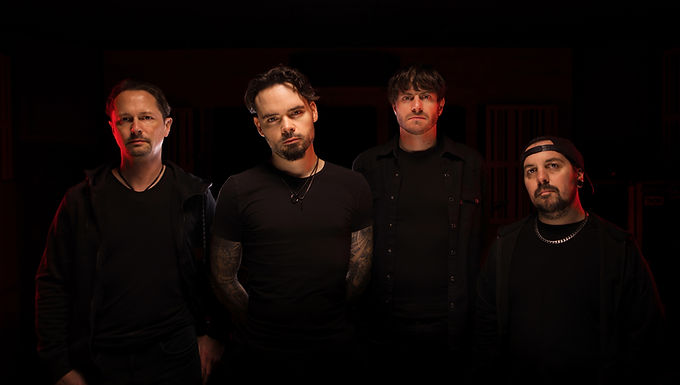
With their new album, Dust In Mind isn’t just evolving. The band is stepping into a true turning point, both musically and personally. A new direction, a new voice behind the mic, and a stronger artistic identity… but above all, a shared desire to stay genuine and aligned.
In this interview, the band looks back on this transformation, how naturally it came together, and what defines them today: a more modern, more cohesive sound that remains deeply human. Between introspection, collective energy, and the need to find one’s place, Dust In Mind delivers more than just an album, they share a journey.
Hello everyone, today we’re here with Dust In Mind. How are you?
Band – Very well, and you?
Very well, thank you. We’re here to talk about your new album coming out on April 24, but also -and most importantly- about this major renewal, this big turning point within the band. First of all, how was the decision made for you, Damien, to take over vocals?
Damien – It happened very naturally, honestly. I think in the life of any band, there are evolutions. You grow over time, your influences evolve as well. We started to feel a shared desire to do something different, with different influences. We wanted to explore. Since Control, which came out in 2021, that shift had already started. We were already aligned toward doing something else, we felt a need for change.
Thomas – You started experimenting.
Jack – And the result was convincing.
Damien – The vocals, at first, were completely random. We had musical ideas, but for the vocals, we didn’t really know where we were going. We were exploring a lot of things, and several people told me, “Why don’t you do it? You should try.” So I gave it a proper shot. Like always, when I do something, I try to do it the best I can so I can have a real perspective on it. That’s how I ended up recording vocals on My Way. When I played it to the others, everyone was surprised, but in a good way. It was unanimous, same for the partners we work with. And most importantly, I really enjoyed doing it. I had a lot of fun with it, and that’s the most important thing.
That’s the most important thing: feeling comfortable and in your place.
Damien – Obviously. And on top of that, it’s completely new for me. And actually, “finding your place” is kind of the main theme of the album.
We’re now facing a more modern, more assertive metal sound. There’s been a real transformation. What was the most difficult part of that change?
Damien – Honestly, it all happened naturally. You just have to listen. We talk a lot, we communicate a lot, and that’s extremely important to maintain cohesion, to stay aligned, to evolve together or decide to change together. You have to stay true. There’s no point in making music if you’re not sincere. So because we’ve been communicating a lot, and for a long time, everything just fell into place naturally. There were no real difficulties.
Despite all these changes, it seems that it didn’t break your dynamic as a band.
Damien – No, it didn’t break anything. On the contrary, it brought something new.
Jack – The synergy has never been this strong, I think.
Damien – We’re really in sync today. And that’s essential. If even one member disagrees, then it’s not a band anymore. We’re also very lucky: we get along really well, it’s natural. It’s not easy to have such a solid line-up. And we also have an incredible team around us. Without them, there’s no show. It’s really a whole. We found each other well, there’s a real energy.
We can feel a more coherent and more mature musical evolution. How did this mix of influences become your new identity?
Thomas – What’s actually funny is that we all evolved individually, listening to a lot of different things, and we realized that we were heading in the same direction. We were sharing a lot of references, even beyond music, and without necessarily talking about it, we had the same vision. That’s why this version of Dust in Mind came together very naturally.
Xavier – It’s a natural evolution. Like a recipe: you start with a base and you add new touches through your experience, what you listen to, what you live through.
Damien – We’re all very different, really. We’re a bit like Friends, each of us has our own personality. But we complement each other perfectly. We have the same desires, the same direction, the same horizons.
It’s not always easy to be different and still look in the same direction.
Thomas – It’s essential. Even more important than the music itself. If you don’t have people who share the same vision and who are willing to give everything to move forward, there’s no point.
Damien – Being in a band requires a huge amount of energy. It’s a heavy mental load. You don’t realize everything that needs to be done. It’s not just about going on stage. You have to produce everything, manage everything, often with limited resources. We kind of have to figure things out on our own. Your personalities better align, otherwise you’ll clash immediately. You have to be mature, know how to take a step back, accept difficult moments. It’s a bit like a relationship. And we’re lucky to have been together for years and to complement each other well.
Jack – In the same way as the themes explored in the different songs, to maintain all of this, at some point you have to be able to question yourself in order to keep moving forward, to stay in something positive. Even when there are moments where you feel like it’s hard, you have to go for it. You have to hold on to something and tell yourself: okay, we’re going to do it.
Damien, I saw that your name is credited for mixing and mastering. So I wanted to ask how that came about. Is it the first time? And how do you think it influenced the album? You were also talking about the band’s chemistry; do you think this was the best way to truly reflect who you are today?
Damien – Well… first of all, we’re broke.
(laughs)
No, sorry… I’ll stop. Seriously, I’ve been producing since the very beginning of the project. I handle the finalization, at least. We come up with ideas together, but I finalize the albums. I have a studio where I do the mixing and mastering, we also record there, and I direct the music videos as well. That’s actually more what I do in my day-to-day life : video production and audiovisual work.
And honestly, it’s quite natural for things to work that way, even if it’s a massive workload. It’s really insane, but strangely enough, it works well like that. With hindsight and experience (even though I’m not that old), I’ve realized that when it comes to translating something, an emotion, handing that over to someone else is extremely delicate. Because if that person doesn’t know you perfectly, and there are four of us, they need to understand all four individuals, with a shared message but also individual nuances. Good luck finding the right person for that. Most of the time, you end up with something and think, “Damn…,” because you had something different in mind. And that can leave you feeling frustrated.
In this case, I happen to know how to do it, so I do it. And I think it’s actually an advantage, especially because nowadays a lot of productions sound the same in terms of tone and rendering. Sometimes you listen to something and you don’t even know which band it is anymore, even if you know them. I think we’ve maybe lost some of that organic and truly personal aspect of music. That’s my personal opinion, and I stand by it.
When everyone goes to the same people for mixing, it inevitably creates a kind of uniformity. The advantage of being in control is that you can do exactly what you feel. The emotion is truly ours. We can say, “Does this feel right?”, “Yeah, that’s it, that’s good.”
And when you have that level of control, you can translate things as faithfully as possible. So the production and the sound end up being a bit different from what’s out there, even if it’s still modern. For example, with vocals, I don’t want to over-produce them. I want a bit of fragility, something organic. Because otherwise, there’s no emotion left, you lose the human aspect. And that’s really important, because we’re losing that more and more today.
“H-C-N-O” : I did a bit of research, I understood what it is, but I’m not sure I fully grasped its meaning. Could you explain it a bit?
Damien – Alright, here we go for ten minutes. (laughs)
Things come naturally, little by little, as we compose the songs. We let things happen, we let the process flow, and we really just do what we feel. And it turns out that “H-C-N-O” is fulminic acid. And if you mix it with another substance, it creates an extremely powerful detonation. You could pretty much wipe out the planet if you wanted to. So the idea is that it’s the first component of several things: actions, reactions, and so on. The goal here was to show that it’s the starting point of something, but that there’s more coming after, and that everything is going to be connected. That’s kind of the core idea. Of course, not everyone is going to ask themselves that question, but that’s also why we’re here.
So yeah, the idea is… do you want the album’s overall theme behind it as well?
That was actually my next question. I wanted to talk about the fact that there are quite dark themes, but ultimately with a rather hopeful message.
Xavier – Yeah, exactly.
Damien – That’s exactly it. Totally. You’re doing great, honestly. You could just do the interview yourself.
(laughs)
Jack – There’s always this idea that during difficult times, instead of focusing on the dark and the negative, you hold on to the positive so you can keep moving forward. It’s about the possibility of affirming yourself by accepting who you truly are. But yes, to sum it up simply: heavy subjects, things that are generally difficult for everyone, but that still show there’s always a way out. The most important thing is to keep in mind that you have to move forward.
Damien – To keep it simple, we can use a chemistry analogy, because it’s really about an exchange of energy: a kind of internal pressure that eventually leads to a collective explosion. The idea is that, in the album, we’re basically talking about someone’s life, in an impersonal way, so that everyone can relate to it. The goal is for people to refocus and find their place again. And to do that, you have to question yourself a lot, look at yourself in the mirror, do things that aren’t very fun, to be honest. It’s a long journey, with ups and downs, that requires a lot of inner work. But when you finally reach that place, when you’ve found it and you accept it -because you also have to accept it- you reach a certain peace, a form of serenity. You feel better, you feel where you belong, and as a result, you have energy to give back to others. That’s really the idea: going through something difficult in order to transform it into something positive and pass it on. And this exchange of energy exists elsewhere too; for example, on stage. We send out energy, there’s an audience, there’s a response… action-reaction. You can find that pattern everywhere.
That’s the fastest I’ve ever explained it, usually it takes seven hours.
(laughs)
So I wanted to talk about something a bit more strategic, and less “creative”: you’ve already released five singles from the album, and they came out in the same order as the tracklist. Was that a deliberate choice?
Thomas – Actually, once again, it just happened by chance that they were released in that order. They flowed well together, so we kept them in the chronological order in which they were created.
Damien – Exactly. Everything happened naturally. The first four came about like that, more or less by chance, simply because the emotion was leading us there. Something was happening, so we followed it. And then at some point, we realized there was something going on, so we started trying to structure it. Because by the fourth one, we weren’t even sure we wanted to tell a story. We didn’t really know. You explore, you try a lot of things. And in the end, we realized we were telling a journey, so we had to follow it through. So yes, we decided to release the songs in that order to tell the story in the right way. Honestly, we try to keep things very natural. You can even hear it in the production: we don’t want to over-produce. We deliberately leave some things a bit fragile. It’s not a negative thing -quite the opposite- it’s to keep something human. Because otherwise, you lose the emotion. And for us, that’s really how we want to express things: by keeping something alive, not completely polished or corrected everywhere.
This is going to be my last question. Out of the nine tracks on the album, five have already been released. So in the end, there are only “a few” left to discover. Is that also a way of adapting to how people consume music today?
Damien – Yes, of course, definitely.
Jack – The fact that we really like to support our singles with music videos plays a huge role. So we release them one after the other with their respective videos. For the last ones, there aren’t any yet, but that will come later. And then there’s also the way music is consumed today; it’s very much centered around singles. Like back in the day with two-track formats, but it changed with digital. There’s also the fact that we needed to make an impact, to build recognition, so we had to release quite a few tracks. And also to get people familiar with the universe we’re proposing, because you can form an opinion about a project with just one song. If you release two singles, you can already start to see a direction. So now, people can really get a clearer idea of what we’re offering.
Damien – And in the end, the idea is to try to tell a story every time. We try to elevate each single as much as possible. When we release a single, we really try to highlight it. Because often, when you release an album, one or two tracks naturally stand out, because that’s what people gravitate towards. And that’s a shame for the others, because we worked just as much on all the tracks. I’m simplifying, but you get the idea. The goal is really to shine a light on everything, because it’s all connected. If someone misses a piece, they won’t understand the full story. So we’re kind of balancing two things: there’s obviously the marketing side -you have to stay present, visible- which can be a bit tiring in our opinion, but that’s how it works today, so we have to adapt. And at the same time, there’s this desire to tell a story. So we have to find the right balance between the two.
First of all, congratulations, because we can really feel all that emotion and cohesion. And finally, one last word: is there anything you’d like to say to the people listening to you?
Thomas – If you don’t have anything planned on May 16th, we’re doing our release show in Strasbourg!
Damien – And if you do have something planned on May 16th, we don’t care. Cancel it.
(laughs)
Thomas – We’re hosting the album release on May 16th in Strasbourg, our hometown, at a venue called La Laiterie. It’s a legendary spot in Strasbourg. We’ll be playing with Akiavel from Marseille and Alita, also from Strasbourg. We can’t wait, and we strongly invite you to come and see what it’s like live. We’re preparing a lot of things, it’s going to be a pretty unique show.
Damien – A unique show, with a unique setup, a new era, a lot of emotion. And on top of that, we’ll be sharing the stage with bands who are friends, really great bands, we have the same energy. So it’s going to be absolutely insane. There’ll be great vibes, it’s going to be an amazing night. And after the show, we’ll be at the merch stand, at home, to hang out, have drinks with everyone. We really want to reconnect and create that exchange of energy.
So on May 16th, whether you have plans or not - figure it out. Get your ticket and come.
Thomas – And we’ll buy you a beer, we’ll do something-
Damien – No, don’t say that!
(laughs)
Thank you very much for your time!
Band – Thank you!